Showing posts with label Elly Griffiths. Show all posts

Monday, December 22, 2014

Review of The Zig Zag Girl by Elly Griffiths (Quercus, 2014)

When two thirds of a body are discovered in left luggage at Brighton station in the summer of 1950, DI Edgar Stephens is assigned to the case.  It appears that the woman was the victim of the Zig Zag Girl trick, whereby a magicians appears to slice a woman in three.  Shortly after the mid-section is sent directly to Edgar.  During the Second World War he had been a member of the Magic Men, a group of magicians tasked with inventing ways to deceive the enemy through illusions, until they were disbanded after a tragic accident.  Edgar turns to his friend, Max Mephisto, who was also a member of the group and is still on the variety circuit.  Max is reluctant to get involved until it is discovered that the dead girl is his former assistant.  Then another former member of the Magic Men is found dead, also staged to look like a magic trick gone wrong.  Aware that they and their former colleagues are under threat Edgar and Max try to unravel the identity of the killer before it’s too late.

I loved the title, cover and premise for The Zig Zag Girl, but was disappointed by the story itself.  I’ve liked Elly Griffiths ‘Ruth Galloway’ series and given my taste for fiction set in the 1930s-1950s, interest in police procedurals and tales relating to the Second World War, I had high hopes for the book.  However, the police procedural elements were unrealistic and the war-time aspects full of inaccuracies and fanciful ideas.  For example, the case concerns a high profile set of murders, yet the only people actively investigating them are a bumbling cop and his magician friend rather than a sizable investigative team.  Moreover, the police response to the threats is minimal, there are no meetings with media, and there is little senior management involvement.  A junior WAAF officer who pushes aircraft round a board in a control room is somehow promoted to head up a whole secret service section.  In Inverness the Magic Men build an aircraft carrier (called a battleship): somehow they can work on it to build it, but it is also so flimsy that a man can’t stand on it to send up a flare so they have to put a woman on it do that job (and she’s lowered on from an aircraft at a time when helicopters were extremely rare).  She shoots the flare, it lands on the very long ship (a few hundred feet) and it catches fire and somehow she can’t get off before it burns out as she’s obviously incapable of jumping into the sea.  The timeline of the war is foreshortened: a few months after the Norway campaign (1940) Edgar’s recruited into the secret service and sent to Inverness (p. 126); after two years there the company is disbanded and he works at a desk job for a couple of months waiting for the war to end (p. 271) -- somehow 3 years have disappeared.  I could go on.  Indeed, the plot in general relied on awkward plot devices and unlikely coincidences and the denouement was very weak.  Further, the narrative had minor continuity errors (e.g., on page 44 Edgar watches Charis die, on page 152 he is told two days later she is dead because he wasn’t there).  I don’t mind some fanciful details or logical inconsistencies in a story, but in this case there were just too many and the result was that I simply did not buy into the tale.  Overall, whilst the premise is interesting, the execution and attention to detail is not and my feeling is the book lacked research and it really needed the attention of a critical editor with domain knowledge of policing and the Second World War to remove/amend the most fanciful bits. 

Friday, March 9, 2012

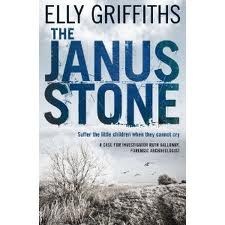
Review of The Janus Stone by Elly Griffiths (Quercus, 2010)

Ruth Galloway is a forensic archaeologist at the University of North Norfolk. She is occasionally used by the local police to help analyze any bones discovered. The last case she was involved in, she ended up sleeping with the lead investigating officer, Harry Nelson, and now she’s pregnant. When the remains of a child are found under the entranceway to a former children’s home that is being demolished to make way for an apartment block, she is asked to take a look. The bones appear to have been buried quite recently and the police start an investigation, once again with DCI Harry Nelson in charge. Ruth and Harry dance awkwardly around each other as the case makes slow progress. Then Ruth starts to be threatened and the case takes a more sinister turn.

Griffiths has an engaging style of writing that draws the reader into Ruth and Harry’s worlds of archaeology and policing, and their awkward relationship. The two lead characters, along with Cathbad, a local druid, are very appealing and the strengths of the book are the unfolding of their relationship and the sense of place of the Norfolk coast. However, whilst the style of the storytelling, the characters and setting are good, the book struggles more with respect to the plot and the mystery. The Janus Stone overly relies on coincidence (there are a fair few in terms of time, place, people, activity) in order to drive the investigation along, and contains a few elements that didn’t stack up. Griffiths has a passage near the end in which a character reflects on the case, thinking that, in so many words, 'such and such was unbelievable, and so was, and also, and yet it was all true'. A direct appeal to readers to forget that they had to suspend their disbelief too many times is not a good sign. Griffiths has a genuinely engaging set of characters and I am hooked on finding out what happens to them when the baby is born, but I really hope that the plotting improves so that it isn’t so dependent on coincidence and unlikely plot twists. Overall, a largely enjoyable read as long as one doesn’t mind suspending their belief every now and then.

Monday, September 12, 2011

Review of The Crossing Places by Elly Griffiths (Quercus, 2009)

Dr Ruth Galloway is a forensic archaeologist specialising in ancient bones, working at the University of North Norfolk. She’s single, independent and living in a small cottage at the edge of the salt marshes. Ten years previously a small child had disappeared in the area. Now the bones of a small body have been found, buried in a henge on the marsh, and Ruth has been asked to examine them by DCI Harry Nelson. Nelson is a man haunted by the missing girl, taunted by a steady stream of letters that claim to be directing him to her, full of references to the bible, Shakespeare and archaeological terms. The bones turn out to be two thousand years old, but hoping that Ruth can help him, he shares the letters. Soon afterwards a second child goes missing and Ruth starts to receive threats.

The real strengths of Griffiths writing is characterisation, inter-personal relationships and sense of place. Galloway and Nelson are both strong, well penned characters, with well fleshed out back stories. There’s clearly a sexual chemistry between them that Griffiths does a nice job of teasing along. And there is a colourful cast of supporting roles that are well observed. What really shines in the book though is the sense of place. Griffith places the reader very effectively in the lonely, rural landscape of the fens and the seascape of the marshes. Where the book is a little let down is with the plot. For the most part it’s fine, but personally I had a hard time believing the conclusion and it all seemed a little telegraphed. Overall, an enjoyable read and I’m looking forward to spending a bit of time with Galloway and Nelson.