The Merry Misogynist is the sixth instalment of the Siri Paiboun series following the investigations and adventures of the Laos state pathologist, who after a lifetime of revolutionary service is rewarded with work rather than retirement. In this outing, Siri seeks to halt the work of a serial killer preying on naïve, young rural women and find a missing Indian man who he’d usually encounter near to his work. In my view it’s probably the weakest of the series so far. While Siri is his usual affable, engaging self, the plot threads felt weak and tired. Each thread was very linear with no twists and turns. The serial killer thread was cliché and the missing Indian made little sense when pressed (he’d left a set of clues leading to where he was, but logically wouldn’t have been able to leave them). And Siri’s spiritual side didn’t surface at all, when it would have made sense to be present. The real saving grace was Siri and his interactions with his close circle of friends and the light humour. I’m hoping the series picks up again as the last couple have been a bit lacklustre, though Siri really is a delightful character.
Showing posts with label Laos. Show all posts
Wednesday, December 9, 2020
Review of The Merry Misogynist by Colin Cotterill (2009, Quercus)
Laos, 1978. A government official with a license to travel the country is wooing, marrying, then killing young virgins in remote rural areas. Most of the victims simply disappear, but one ends up on the mortuary slab of Dr Siri Paiboun, the national coroner. Appalled at the manner of her death, Siri decides to investigate, teaming up with the detective married to his nurse. As well as hunt a serial killer is also fighting a personal battle with the housing department and searching for an itinerant Indian man who has disappeared from the streets of the capital.
Tuesday, March 13, 2018
Review of The Curse of the Pogo Stick by Colin Coterill (2008, Soho Press)
Dr Siri, the reluctant national coroner of Laos in the aftermath of communist victory in 1976, has had to travel to a national congress in a remote district. Afterwards he is commanded to journey through the jungle with his cowardly and hectoring boss, Judge Haeng, where they are attacked by a Hmong family. Haeng disappears into the undergrowth where he is ill-equipped to survive, while Siri is kidnapped. The elder of the family wants Yeh Ming, the thousand year old shaman that inhabits Siri’s body, to exorcise a devil from his daughter before they head to the Thai border to escape persecution on ethnic grounds and for siding with the anti-communists. Meanwhile, back in Vientiane, Nurse Dtui is keeping an eye on the mortuary in Siri’s absence. Her first task is to stop a booby-trap corpse blowing up the building and its occupants. Then, along with Madame Daeng, Siri’s financee, she starts to investigate, soon finding herself chasing a deadly woman known as The Lizard.
The Curse of the Pogo Stick is the fifth book in Dr Siri series set in Laos in the 1970s, which I’ve slowly been working my way through in non-sequential order. In this outing, Siri is kidnapped by a Hmong family who want him to draw on his inner shaman to exorcise a devil from a daughter and lift the curse of a pogo stick sourced from the US military. Meanwhile, Nurse Dtui, Inspector Phosy, Madame Daeng and Civilai take on a Royalist terrorist, The Lizard, who is targeting the coroner’s office. Of the six books I’ve read so far, this is weakest. While it has its moments, my sense was the book was a bridge between entries in the series rather than being a full developed story in its own right (which I also said about the previous book in the series). The issue I think is that story consists of two shorter tales, one underdeveloped and the other also slightly under-cooked, that run in parallel. The thread involving Siri’s usual gang of helpers and The Lizard was particularly weak, largely due to a change in telling of the story. In the first hundred pages or so the thread was told in the present, running side-by-side with Siri’s adventure. It then disappeared, re-emerging near the end as a tale told in retrospect once Siri is back with the gang. That gap and the change in storytelling style simply didn’t work for me and the tale felt weak and lacking in intrigue and twists and turns. Siri’s thread while having more substance felt too static once he gets to the Hmong village and the denouement felt curtailed. My sense was that tale needed more movement and tension, which might have been created if the judge had played a more confrontational role and Siri had gone on the journey towards the Thai border with the family for at least part of the way. What saves the book are the characters, which are a delight, and the world that Coterill has created, which is always interesting to visit.
Friday, May 19, 2017
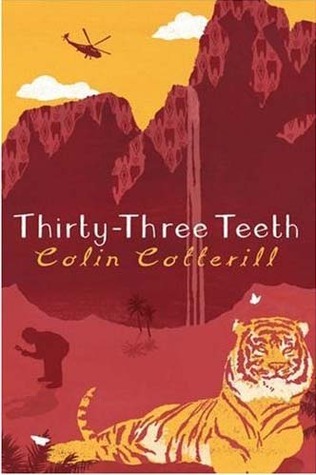
Review of Thirty-Three Teeth by Colin Coterill (Quercus, 2005)
Laos, mid-1970s, the country is transitioning to a new communist government. After many years hiding in the jungle and now in his seventies, rather than retirement Dr Siri Paiboun has found himself the new national coroner. He has also discovered he is host to an ancient spirit, which has opened up a whole new world. His new role examining the recently deceased and his ability to see dead spirits poses many questions and mysteries. His natural curiosity and willingness to resist and subvert the wishes of the political regime lead him to investigate deaths that others would prefer to be ignored. He is aided in his exploits by the formidable Nurse Dtui, Mr Geung, his mischievous mortuary assistant with Downs Syndrome, Inspector Phosy, and his long-term ally and senior politician, Civilai. When a bodies start to turn up with an unusual bite marks, Siri starts to investigate. He is distracted by a man who seems to have taken a running jump from the seventh floor of a government ministry, and a trip south to where two men have mysterious been burnt to a crisp. In the meantime, Nurse Dtui pursues her own line of inquiry.
Thirty-Three Teeth is the second book in the Dr Siri series set in Laos in the 1970s. Like the first in the series there is much to like about the story and storytelling. The real delight is the characterisation, especially Dr Siri, Nurse Dtui, and mortuary assistant, Mr Geung, who are all extremely likeable, multidimensional characters with interesting back stories. Dr Siri, in particular, shines with his easy-going charm and slightly rascal persona. Added to this is: the sense of place and time in the early days of the communist regime in Laos; the mythical and spiritual elements that sit easily into the tale without seeming contrived or oddly supranatural; and the unusual mysteries that are investigated. The result is a warm-hearted, charming and enjoyable tale that blends crime and social/historical commentary with magical realism to great effect.
Monday, September 2, 2013
Review of Love Songs from a Shallow Grave by Colin Cotterill (Quercus, 2010)
It’s 1978 and Dr Siri Paiboun, Laos’ only coroner, is approaching his seventy fourth birthday. After a lifetime of serving the communist party and finally witnessing the Laos revolution he would like to retire. Instead, he is tasked with examining the body of a young woman found dead in a sauna on a former American base that now houses many of the present ruling elite. The woman has been stabbed through the heart with a epee, a small z carved in her thigh. Siri’s friend, Inspector Phosy, is tasked with investigating the case. The following day another young woman is found dead, similarly with an epee through the heart and a z cut on her thigh, shortly followed by a third case. It seems that there is a serial killer on the loose. As usual, Siri can’t help becoming involved in the investigation, but initially he’s baffled. He’s also distracted by disturbing dreams, Nurse Dtui’s domestic problems, and the endless rain. Just as he starts to make progress he’s asked to go on an official trip to Kampuchea controlled by the Khmer Rouge, which is when his real troubles start.
Love Songs from a Shallow Grave is the seventh book in the Dr Siri series. Of the four that I’ve read it’s the strongest in terms of the plot, which is very well constructed and executed, blending a nice mystery puzzle with a strong sense of place and fascinating historical and social context. Whilst the tale still has some of the comic charm of the other books, both of the intersecting storylines are dark, especially Siri’s time in Kampuchea, which is quite harrowing but well handled. And although the story principally follows the investigation and the official trip, Cotterill advances the personal lives of the stable of main characters Siri, Madame Daeng, Nurse Dtui, Inspector Phosy, former Minister Civilai, and Mr Geung. Indeed, a real strength of the book is that the full gang are present for nearly the entire tale, each with their own interesting subplot. Overall, a clever, dark and enjoyable tale with a fascinating geographical and historical context.
Friday, September 25, 2009
Review of Disco for the Departed by Colin Cotterill (Quercus, 2006)
It’s 1977 and the communists have recently come to power in the newly named, People’s Democratic Republic of Laos. Dr Siri Paiboun, a cynical party member for fifty years, a former surgeon who has served in the long campaign against the royalists, and who has recently discovered his shamanic powers, has become the reluctant state coroner, a role he serves with humility and humour, along with Nurse Dtui his independent but faithful assistant, and honest and patient Mr Geung, a young man with Downs Syndrome who looks after the mortuary. Following the discovery of a mummified arm in a concrete path leading the President’s new house in Vieng Xiu, in the north-east of the country, where the revolutionary army had made their base in caves below the karst hills, Siri and Dtui journey north from Vientiane, the capital. Their task is to help Comrade Lit of the security division, who is charged with investigating the find and closing any case before a special concert to celebrate the signing of a treaty with Vietnam is held a few days time. Dr Siri soon determines that the man in the concrete was black, that the only men of that colour in the area were two Cuban nurses, and that the victim did not die a natural death. Local rumour is that the two Cuban nurses were exponents of Palo Mayombe, a form of black magic, and that they had used it to gain power over people including the beautiful young daughter of a Vietnamese colonel, hence why they had supposedly been sent home a few months earlier. Soon Dr Siri is investigating whether the man in the concrete is one of the nurses and how and why the victim became embedded in the path. In the meantime, Judge Haeng has taken the opportunity of Siri’s absence to transfer Mr Geung three hundred kilometres to the north. Mr Geung had promised Siri he would look after the mortuary, so slipping away from his abductors he starts to walk south, undertaking his own eventful adventure.Disco for the Departed is the third book in the Dr Siri series, and the first I've read. It is described on its cover as having ‘comic charm’ and I wouldn’t disagree. Whilst I only laughed out loud a couple of times, I found myself often smiling along to the story and its understated and sly wit. In Siri, Dtui and Mr Geung, Cotterill has fashioned three well drawn characters which are not only very likeable but wholly believable, and the supporting cast were also well depicted. The story is well crafted and plotted, rich in detail and insights, and snakes and twists to a satisfying end. In particular, Cotterill does a good job of setting out the history and geography of Laos in the 1970s without this contextual material swamping or detracting from the story. It is also to his credit that I never once questioned Siri’s shaman abilities; instead I simply accepted it at face value that he could interact with the spirit world. All in all, Disco for the Departed was a very pleasant read and I look forward to reading more of Siri, Dtui and Mr Geung’s adventures.
Subscribe to:
Posts (Atom)