Showing posts with label 2009. Show all posts

Thursday, December 10, 2015

Review of Lennox by Craig Russell (2009, Quercus)

Rather than heading back to Canada after being demobbed, Lennox settles in Glasgow, creating a role for himself within the underworld as a private investigator.  In the spring of 1953 one of the McGahern twins, a pair of vicious gangsters, is murdered.  The second twin wants Lennox to find his brother’s killer, but shortly after he’s also found dead.  The three kings, the crime bosses who run the city’s three main gangs, want the killers found.  The police think Lennox is a likely suspect.  A little probing reveals that there is far more to the  deaths of the twins than first meets the eye.  It seems that a fourth criminal gang is operating in the city and they’re well organized.  Moreover, they’re leaving a trail of bodies in their wake, erasing possible leads before Lennox gets a chance to talk to them.  With the police turning the heat up against the three kings and Lennox, he tries to keep one step ahead of the law and to run down the McGahern’s killers.

Lennox is a gritty PI tale set in Glasgow not long after the end of the Second World War.  Naturally cynical, hardened by the war and tenacious, Lennox is well able to look after himself on the tough streets of the Scottish city, offering services to shady characters, including the three kings, the rival leaders of the main three gangs.  Russell tells the tale of Lennox’s attempt to solve the murders of the McGahern twins in a first person voice that is genuinely engaging and brings 1950s Glasgow to life.  Moreover, the plot rattles along a jaunty pace, with plenty of action, tension, and twists and turns.  The story is all a little far-fetched, especially the denouement, but it little matters as it’s a rip-roaring read.  Overall, an entertaining tale that introduces a tough-guy, wise-cracking PI who has some depth and substance.


Friday, April 24, 2015

Review of Pandaemonium by Christopher Brookmyre (Abacus, 2009)

After witnessing the murder of a fellow pupil, senior students of St Peter’s High School are taken on a weekend retreat to a secluded outdoor centre in the Scottish Highlands. Divided into cliques and full of hormones, anxieties, sexual insecurities and curiosities, and bravado, as well as counselling and prayer there’s an expectation of parties and clandestine liaisons.  Accompanying them are three teachers and a young priest, hoping they can maintain control.  Nearby, at a top-secret military base scientists and priests are conducting an experiment that seems to have opened a portal into Hell.  Fighting for control of the project and its future, with the military and ensnared demons in the middle, it looks like religion is going to get its way and the portal closed.  Similar debates about science and theology, philosophy and faith, are happening at the retreat, but very soon they are going to be put into practice as two worlds collide.

There are two great strengths to Pandaemonium: the wonderful way in which Brookmyre captures the personalities, insecurities and interactions of school trip to an outdoor centre; and the exploration of the themes of science and theology.  Although it was sometimes a little confusing trying to follow the stories, insecurities and interrelations between thirty or so characters, the teenage angst and clique dynamics is very well evoked.  In contrast, whilst the scientists and priests in the secret research centre are well penned, they lacked the same vitality.  Where that thread of the story excelled was in the exploration of scientific philosophy and faith, with some really great passages about physics and theology.  Running through both threads is a nice streak of dark humour.  Up to about two thirds of the way through I thought the book was fabulous – insightful, rich, layered and fun.  Then it takes an altogether darker turn towards horror as the two worlds of the outdoor centre and the research labs collide, with some fairly graphic violence and the more literary, thoughtful storytelling being jettisoned for gory action.  And whilst Brookmyre tries to pull it all back round to philosophy and theology in the last few pages, it seems to end a little too abruptly and without a clear sense of the thoughts of all the leading characters.  Nonetheless, Pandaemonium was a great read – lively, engaging, thought provoking, with a dollop of black comedy.


Wednesday, January 28, 2015

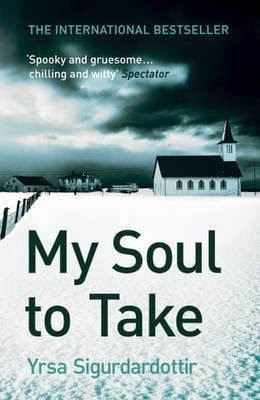
Review of My Soul to Take by Yrsa Sigurðardóttir (2009, Hodder)

Thóra Gudmundsdóttir is a lawyer based in Reykjavik who has overseen the sale of an isolated property to a businessman who has turned the place into a new age hotel.  Only there is a problem -- the property is haunted and he wants compensation from the sellers.  Thóra is invited out to the hotel to investigate and whilst she is there the hotel’s architect, Birna, is found beaten to death with pins inserted into the bottom of her feet.  Rather than leave the death to the police, Thóra decides to investigate, stealing the dead woman’s notebook.  Soon she is advising the hotel owner, who has become the prime suspect.  It soon becomes apparent to her that the haunting and death are connected to the convoluted and tragic history of the family who owned the property.  However, uncovering that past and the killer is not straightforward for an amateur sleuth that the police do not trust.

My Soul to Take is the second book in the Thóra Gudmundsdóttir series set in Iceland.  It is effectively an amateur sleuth tale, with Thóra running her own investigation that parallels, and at times, undermines the police’s work.  The story is lively and engaging with a nice blend of various sub-plots concerning the contemporary investigation, the past concerning the hotel site and its former owners, and Thóra’s family.  Sigurðardóttir populates the story with a mix of characters that all have possible motives for murdering the hotel architect or lack a convincing alibi, and keeps many of them in the frame for a sizable chunk of the tale, slowly whittling down the list of suspects.  That said, it’s clear that it’s one of two people, and the reason why, from quite a long way out.  The Icelandic landscape also provides an atmospheric backdrop.  The pace is quite leisurely, with Sigurðardóttir spinning the tale out through a series of blinds, feints and tension points.  My main issue with the tale was the amateur sleuth angle - Thóra’s actions, especially with respect to evidence and the police, or why various suspects are prepared to talk to her, is not really clear.  Putting this issue of credibility to one side, the story is entertaining read.


Thursday, January 15, 2015

Review of Red Bones by Ann Cleeves (Pan, 2009)

On the small island of Whalsay in the Shetland Isles two young archaeologists are undertaking a dig on the croft of the elderly Mima Wilson, hoping to find the remains of an old merchant house.  In a practice trench they discover a human skull and other bones.  The following night Mima is shot dead in a seemingly tragic accident.  Inspector Jimmy Perez journeys to the island to investigate, aided by Sandy Wilson, the grandson of the deceased.  Perez is not convinced it’s an accident, but there’s little evidence to suggest foul play.  As the two cops probe, the long-standing tense relations between two island families surface, with rumours circulating as to the provenance of the old bones.  When a second death occurs, this time a supposed suicide, Perez knows he’ll need to use the past to flush out the killer before they strike again.

Red Bones is the third book in Ann Cleeves Shetland series featuring Inspector Jimmy Perez (here are my reviews of books 1 and 2).  The strength of the tale is the sense of place, atmosphere, characterisation and social relations.  Cleeves drops the reader into the wild landscape and seascape of the Shetland Isles, vividly portraying the desolate and isolated beauty and the close relationship between people and place.  Moreover, she nicely captures the close knit nature of small communities, inter-linked through familial connections and generations of friendships and rivalries, and uneasy relations with blow-ins and visitors.  The style is quite descriptive, providing plenty of detail about each character, their back story, the settings, and historical context.  This works to produce an interesting narrative, but also leads to a slow pace, perhaps fitting of the setting and tale, and to some repetition in observations.  The plot is relatively straightforward and I felt the police procedural elements were a bit thin, especially with respect how each death is dealt with, for example in terms of postmortems which should have been standard and would have transformed the investigation.  Rather it is driven more by gut instinct and a certain amount of bumbling around.  Overall, an enjoyable, atmospheric tale.


Monday, October 27, 2014

Review of The Bellini Card by Jason Goodwin (Faber, 2009)

Istanbul, 1840, and there is a reshuffling of power as a new sultan succeeds the old.  The young sultan has heard a rumour that a portrait by Bellini of his ancestor, Mehmet the Conqueror, has resurfaced in Venice.  Yashim, a palace eunuch and detective, is asked to quietly investigate whether the painting exists and is for sale.  Not wanting to draw attention to sultan’s interest, Yashim sends his friend, Palewski, the Polish ambassador to Istanbul to Venice.  Given that Venice is in the control of Austrian authorities, and their recent conflict with Poland, Palewski adopts the disguise of a rich American seeking masterpieces to take back to the new world.  Venice is a shadow of its former glory, but its people still possess the guile and hospitality that made it a key Mediterranean trading port.  Palewski is soon moving in a world of old aristocratic families, dealers and cunning guides, seeking the fabled Bellini, but so is a killer who’s leaving a trail of bodies in his wake. 

The strengths of The Bellini Card are the sense of place, characterisation, and historical detail.  Goodwin places the reader in both Istanbul and Venice -- the landscape and architecture, the sights, sounds and smells, and the social strata and living conditions.  The descriptions are wonderfully evocative and come to life in one’s mind’s eye.  This is aided by a melting pot of nicely drawn characters -- a mix of fading aristocrats, bureaucrats, servants and criminals -- and their interactions conditioned by social standing.  This is all well framed with respect to byzantine politics and the long history of connections between the two cities.  The plot, however, is also somewhat byzantine.  It might have been because I was tired when reading, but as the story progressed I became increasingly lost as to logic driving the story and I reached the end without really understanding the denouement.  Maybe if I read it again it would become clear, but on first reading the complex weave and twists in the story never fully unravelled to reveal themselves.  The result was a tale I enjoyed for the rich portrait of people and places, but where the plot became evermore incidental.


Tuesday, July 15, 2014

Review of Washington Shadow by Aly Monroe (John Murray, 2009)

After spending time in Spain and Germany as an agent in the Economic Warfare Unit in the summer of 1945 Peter Cotton is sent to Washington DC.  John Maynard Keynes and a British team of negotiators are in the city trying to secure a loan to keep a bankrupt Britain afloat.  A new world order and the cold war is emerging and the city is full of intrigue and spies who circulate through endless embassy parties.  The Americans are reorganising their intelligence agencies and seem intent on destabilising British imperialism and growing their own spheres of influence.  Cotton’s job is to circulate the parties and to try and pick-up useful information, and to build a relationship with an African-American scholar interested in the fate of Africa post-war and a former Soviet tank commander who seems to be his equivalent appointment in the Soviet embassy, reporting the results to his abrasive boss, Ayrtoun.  Whilst he tries to find his feet he meets Katherine Ward, a beautiful analyst who works in the State Department and they start a tentative relationship.  All the while, Keynes is struggling to get a workable financial deal. 

Washington Shadow is the second book in the Peter Cotton series following the exploits of an economics graduate who works as an intelligence officer (here are my reviews of books 1 and 3).  Whilst the first book was set in Spain, the second sees Cotton move to Washington DC after his old unit is wound up and he waits to find out if he’s going to be demobbed.  Despite winning the war, Britain is on its knees financially and is severely weakened politically with respect to its empire.  The nice hook to the story is John Maynard Keynes presence in the city, trying to negotiate a loan from the Americans.  The first half of the tale is atmospheric and evocative, and the historical contextualisation concerning the relationship between the US and Britain is interesting.  Cotton is a little out of his depth and struggling to work out his role in what seems a fluid situation as the Americans re-organise their intelligence agencies and prepare for a new world order, and he hesitantly starts a relationship, his first serious one since the death of his fiancée to a blitz bomb.  However, in the second half the storyline becomes a little disjointed, bitty and opaque, and rather than Cotton being at the centre of the action with respect to the Keynes negotiations, which might have provided a stronger hook, he’s hovering around the edges with an uncertain role.  Perhaps Monroe is projecting the uncertainty and haphazardness of the British position onto Cotton, but it means the plot fizzles rather than sparkles.  This was a shame as the first half was excellent.  Nevertheless, it’s still an interesting read, with an engaging lead character and intriguing context.


Wednesday, July 9, 2014

Review of Dog On It by Spencer Quinn (Pocket Books, 2009)

Chet, a K-9 trained dog who failed his final examine, lives and works with Bernie, a divorced, ex-army, ex-cop, private investigator.  Together they toil in an unnamed desert city in Arizona, barely making ends meet, Bernie struggling to make childcare payments to his ex-wife. When a local mother calls after her fifteen year old daughter has disappeared they take the case.  The father is certain that the daughter has run away, but Bernie thinks differently, though the lack of a ransom note seems to rule out kidnapping.  Then their car is vandalized and Chet tasered and nabbed.  But Chet is no ordinary dog and once he and Bernie vow to find a missing person they stick to the task whatever the risks.

Dog On It is told entirely from the point of view of Chet, a well-trained dog with a great sense of smell, an intuitive ability to read humans, who’s loyal and brave, and is easily distracted by food and the prospect of some fun.  The narrative voice is engaging and well pitched and anyone who owns a dog will recognize his canine mind at work.  The result is the reader is soon rooting for Chet the Jet and Bernie, his world weary, laconic private investigator owner, who can handle himself in a tight corner when needed.  Indeed, the book thrives on the equal partnership.  There’s a cozy sensibility to the tale, with a gentle humour running throughout, but Quinn doesn’t shy away from tough and dangerous moments, building the tension at a number of points in the story.  The plot of tracking down a missing fifteen year old is relatively straightforward, with no major surprises, but it’s interesting enough.  The real strength of the book, however, is the characterisation and the relationship between Chet and Bernie.  Overall, an entertaining read that will appeal to all dog lovers, or those looking for a mystery with a novel point of view.


Wednesday, July 2, 2014

Review of The Gigolo Murder by Mehmet Murat Somer (Penguin, 2009, Turkish 2003)


In a funk after his boyfriend dumps him, the anonymous transvestite narrator of the story has locked himself away in his Istanbul apartment, ignoring the drag queen club he owns and the computer company he hacks for.  Worried about his welfare, close friend and fellow drag queen, Ponpon, comes to rescue and rehabilitates him, before dragging him out to the club he performs in.  There he meets a handsome lawyer, Haluk, immediately becoming smitten despite the presence of his wife.  During their encounter, Haluk receives a phone call to say his wife’s brother, Faruk, a rich moneylender, has been arrested for the murder of Volkan, a minibus driver and noted gigolo.  Solving the murder might endear the sometime amateur sleuth to the lawyer, so dressed like his heroine, Audrey Hepburn, he sets about snooping, visiting Volkan’s dysfunctional family and some of his lovers, and also catching up on some of his hacking duties, which appear to have some bearing on the case.  Then the accused is killed shortly after our hero(ine)’s visit and things really start to hot up.

The unusual twist in Somer’s Hop-Çiki-Yaya series set in Istanbul, Turkey, is the amateur sleuth: a gay, transvestite drag queen, who is vain, camp, catty, impulsive, dramatic, brave, and wears his heart on his expensively clad sleeve.  He’s also a dab hand at Thai boxing and a skilled computer hacker.  He leads a colourful life, surrounded by a menagerie of larger than life and quirky characters and a penchant for putting his nose in where it’s not necessarily wanted.  The result is an interesting lead character whose boundary challenging exploits are good fun to follow.  Indeed, The Gigolo Murder has a streak of light humour running throughout.  The plot is appealing enough, charting the investigation in to the death of a man abused as a child and exploited as an adult by his family, and it provides an interesting glimpse of different elements of Istanbul’s subcultures: minibus/taxi drivers, drag queen clubs, rich high society.  There’s plenty of twists and turns, though it relies on a couple of plot devices at times.  Overall, an entertaining read and a fresh contribution to the genre.


Thursday, February 13, 2014

Review of All the Dead Voices by Declan Hughes (John Murray, 2009)

Private Investigator Ed Loy has been hired to do two jobs.  The first is keep an eye on up-and-coming footballer Paul Delaney, who seems to have fallen into the orbit of Dublin gangster, Jack Cullen.  The second is to look into the murder of a tax inspector fifteen years previously on behalf of his daughter.  The case was seemingly solved, but the convicted man was released on appeal after evidence withheld from the first trial came to light.  That evidence revealed that Brian Fogarty had been investigating the tax affairs of three men, two known gangsters, George Halligan and Jack Cullen, and a now wealthy businessman, Bobby Doyle who is on the verge of opening a landmark bridge in the city.  Cullen is a long time member of the IRA and is now in a bitter dispute with the INLA over drug turf in the city.  The last thing he wants is Loy digging around in the past.  Then two hoodlums that attack Loy are found dead, and so is Paul Delaney, and the past rushes forward to meet the present, and a complex and dangerous game starts to unfold.

All the Dead Voices jaunts along at a nice pace, with plenty of intrigue and action as private investigator Ed Loy tries to make sense of the two cases he’s taken on that quickly become entwined in lethal ways.  Hughes writes with an engaging voice and quickly hooks the reader in.  The characterisation and social and historical context is nicely realised, with a good sense of place regarding Dublin and the tail-end of the Celtic Tiger boom and the period immediately prior to the peace process.  The story is quite complicated, yet the plot remains clear to follow, with a nice mix of threads and intrigue.  However, one does have to suspend one’s sense of belief for the plot to work given the coincidences of the two intersecting plots, Loy's acquaintance with a number of characters,  and at a number of points I kept wondering why Loy was still alive?  Nevertheless, the story is an entertaining and enjoyable addition to the Ed Loy series.

Thursday, November 21, 2013

Review of Hunting Eichmann by Neal Bascomb (Quercus, 2009)

Adolf Eichmann was the operational manager in charge of the logistics of making the ‘Final Solution’ happen.  His job was to plan and coordinate the rounding up of Jews from across Europe, to strip them of their assets, and ship them to ghettos and death camps.  At the end of the Second World War he took on another identity and went underground.  In 1950 he used a ratline to escape Germany, travelling to Argentina, where his wife and three children joined him.  Unlike other Nazis, he had not looted for his own ends and his life in Argentina was very modest.  Initially omitted from the most wanted list, as the extent of his war crimes became clear, Eichmann soon rose to become one of the most sought after Nazis.  By the end of the 1950s, however, the appetite to hunt down war criminals had waned, except amongst a dedicated group determined to see justice administered.  When they received the news that Eichmann was living in a Buenos Aires suburb they agitated for action and in May 1960 a team of Mossad agents snatched Eichmann and smuggled him out of Argentina to Israel.  There he was put on trial for crimes against humanity.  Eichmann did not resist his capture, nor deny his crimes, but rather sought to argue that he had simply been carrying out his orders and duty.  He was hanged in June 1962.

Hunting Eichmann focuses on the hunt for and capture of Eichmann, concentrating on the period from the end of the Second World War up until his arrival in Israel.  As such, it sketches over Eichmann’s career within National Socialism and his activities during the war, and also his trial in Israel.  In this sense, the book is very much about the search for him by various people and groups and the planning and execution of his capture by an Israeli Mossad team.  Through extensive research, Bascomb produces a compelling narrative of how various events unfolded and all of the key personnel and their relationships and interactions.  The result is a telling that has the feel of a novel, rather than a dry and detached history.  In particular, the reader gets a sense of the personalities and politics at play, and the wider resonance of Eichmann for Holocaust survivors.  Personally, I would have liked a little more detail on Eichmann’s career and also the trial, but this is nonetheless a fascinating and well told read of how one of the most notorious war criminals of the twentieth century was brought to justice.


Friday, September 6, 2013

Review of Stettin Station by David Downing (Old Street Publishing, 2009)

November 1941, the Wehrmacht has ground to a halt outside of Moscow and the relationship between Japan and the US is deteriorating.  John Russell, a British journalist with an American passport and long term resident of Berlin, can sense the winds of change.  He’s loathed to leave his thirteen year old son or his long term girlfriend, actress Effi Koenen, but it’s clear he needs to try and find a way to out of the country whilst remaining in contact.  One prospect is to act as a point of contact between the Americans and the Abwehr.  Another is to gather evidence of significant interest to the Allies and, in particular, the communists so that he can use their escape lines.  However, just as he’s putting both arrangements in place the Gestapo and SD re-awaken their interest in his presence and activities, potentially jeopardising his plans. 

Stettin Station is the third book in the John Russell and Effi Koenen series.  The strengths of the tale are the characterisation, sense of atmosphere and place, and the historicisation.  Russell and Koenen are well realised and rounded characters and they are accompanied by a broad spectrum of nicely penned others, including journalists, administrators, various forms of police, family, friends and other citizens.  Downing manages to nicely blend the everyday realities and complexities of living in Berlin during the war with the politics and machinations of a police state and his role as a foreign journalist.  The result is a story that captures the everydayness of getting on with lives in a state of perpetual background fear, and the tactics of surviving and resisting.  Moreover, by utilising real events and occasionally real historical characters, Downing provides a semblance of authenticity.  Where the book suffers a little is with regards to the plot.  Whilst it is an interesting story the tale seemed largely a transitory one, moving the characters into place for the next instalment rather than having its own self-contained arc and denouement.  Moreover, the ending seemed somewhat contrived and didn’t ring true to me.  Nonetheless, Stettin Station is a solid addition to a very good series and I look forward to reading the next instalment.


Monday, May 13, 2013

Review of The Third Pig Detective Agency by Bob Burke (2009, The Friday Project)

Having survived the Big Bad Wolf attack, Harry Pigg operates a down-at-heel private investigations agency in Grimmtown.  Barely making ends meet he’s approached by the super wealthy, Aladdin, who wants him to recover a stolen lamp.  Pigg knows the case reeks of trouble and takes it on under duress.  Sure enough he’s soon piggy-in-the-middle of a deadly, three-way pursuit for the lamp.  What he needs is a clever solution that’ll save his bacon.

The premise for The Third Pig Detective Agency is a good one -- take the characters and fables from fairytales and fashion them into detective stories with a noir framing and a dollop of black humour.  Jasper Fforde has used the same premise in his Nursery Crimes series.  For the most part, the book is a fun read.  The story is cleverly structured, with a well worked resolution.  The plot, however, is a little thin in places, with some elements under-played.  For example, Edna, the Wicked Witch of the West, is largely reduced to a bit part and the sequence in her domain very linear and too quickly and easily resolved.  Moreover, the writing, whilst capturing some of the style of noir fiction, was too often flat and clunky.  Nevertheless, it’s a fast-paced, light-hearted, enjoyable story suitable for kids and up and on this outing I’d give the other books a try.


Tuesday, January 5, 2010

Most popular posts of 2009

I thought I'd take a look at the blog's traffic since its inception in July until the end of 2009 and find out which posts were the most popular (beyond the top level; and I don't have a clue how many people are reading in a reader). Overall visitor traffic is remarkably flat, with a few spikes.

The spike towards the end is my recent Blogs of the Year post which, thanks to a plug on The Rap Sheet, attracted quite a few visitors. Up until then, my most popular post on any single day had been my review of Go to Helena Handbasket by Donna Moore. The most popular individual posts of the year across the whole period were:

Review posts
1. The Lime Pit by Jonathan Valin
2. Go to Helena Handbasket by Donna Moore
3. The Devil's Star by Jo Nesbo
4. Black Out by John Lawton
5. The Killing of Strangers by Jerry Holt
6. The Small Back Room by Nigel Balchin
7. The Tin Roof Blowdown by James Lee Burke
8. The Builders by frank McDonald and Kathy Sheridan
9. Harold Shipman: Prescription for Murder by Brian Whittle and Jean Ritchie
10. Inspector Mallon by Donal McCracken

General posts
1. Blogs of the Year
2. The monster arrives
3. Pre-order splurge
4. Necessary evil?
5. Putting cartography back on the map
6. Back to square one
7. I don't remember
8. Ohio-Kentucky crime fiction
9. The lazy Sunday service (6th Sept)
10. Rethinking maps

Overall, the general posts received more visits than the reviews, which surprises me. And of the reviews, only Go to Helena Handbasket is one of my books of the year. Having kept an eye on traffic I am still completely clueless as to what posts will and won't attract interest, which is probably no bad thing. Thanks to everyone who has stopped by in 2009 and became a tiny bit of the blue line above.

Friday, January 1, 2010

Best crime novel reads, 2009

A great year of reading. Since starting to blog my reading has had a fresh burst of life as I've discovered loads of new authors and their work (all but one of the books below were authors new to me this year). I'd like to thank all my fellow crime fiction bloggers who have done so much to diversify and enliven my reading over the past few months, especially those who gave me specific recommendations.

Here are my top ten reads of 2009 (from when I started my blog reviews in July), only three of which were published in 2009.

1. Alone in Berlin by Hans Fallada (1947 in German, translated 2009)

2. Winter's Bone by Daniel Woodrell (2006)

3. Diamond Dove by Adrian Hyland (2006)

4. The Collaborator of Bethlehem by Matt Beynon Rees (2007)

5. The Wheelman by Duane Swierczynski (2005)

6. The Foreign Correspondence by Alan Furst (2006)

7. Fifty Grand by Adrian McKinty (2009)

8. Walking the Perfect Square by Reed Farrel Coleman (2002)

9. Go to Helena Handbasket by Donna Moore (2006)

10. The Twelve by Stuart Neville (2009)

I'll be submitting these to Kerrie over at Mysteries in Paradise who is running her annual collection of best crime reads, 2009 (nominated books do not have to be published in 2009). To participate click here.

Alone in Berlin was the stand out book for me; an astonishing novel first published in German in 1947. A book I've recommended to many people.

Thursday, December 31, 2009

So long 2009

All years have their ups and downs, but for me personally 2009 had more ups than downs - in fact, in many ways, it's been a bit of a stellar year. I'm probably a little unusual in that respect vis-a-vis most people in Ireland as the year has generally been an unmitigated disaster with rapidly rising unemployment, wages cuts, collapsing house prices, severe flooding, and general all round misery.

From my perspective though:
The Rule Book finally saw the light of day.

The 12 volume International Encyclopedia of Human Geography was published.

Rethinking Maps followed shortly afterwards.

I submitted two new books - Code/Space: Software and Everyday Life (MIT Press) and the 2nd edition of Key Thinkers on Space and Place (Sage)

We put up the Atlas of Cyberspace up as free PDF download (my only book to briefly break into Amazon top 100 sales rank) and gave it a new life.

I finished a ten year stint as Editor of Social and Cultural Geography

I was appointed Editor of Progress in Human Geography

I got the green light to start a new journal, Dialogues in Human Geography (Sage)

The first books in the Key Concepts series I edit were published (Sage) and the first books in the Irish Society series were commissioned (Manchester University Press).

I travelled to some interesting places: Armenia, Ohio, Kentucky, Nevada, Utah, Arizona, Germany, UK

We moved into the Blue House back in January

I started two blogs - The View from the Blue House in July, and Ireland After NAMA in November.

I discovered the world of blogging in general and some great blogs and communities

My reading got a new burst of life as I discovered loads of new authors whose other works I want to read and I read loads of fabulous books.

On the negative side, I've taken a 20 percent cut in my take home pay and been trying to fight a rearguard action on cuts to the institute I run. 2010 will be an interesting year on that front. I'm genuinely worried about the hole Ireland finds itself in and the government's handling of the crisis, and my fear is that things are going to get worse before they get better and it'll be a slow climb back to where we were. I also failed to find either agents or publishers for Saving Siobhan and The White Gallows.

I doubt I'll have another year like that any time soon. So long 2009, you were a rare vintage ...

Sunday, December 27, 2009