Showing posts with label James Sallis. Show all posts

Monday, April 6, 2020

Review of The Eye of the Cricket by James Sallis (1997, Oldcastle Books)

Lew Griffin is a some-time English literature academic, some-time detective, and always melancholy with a self-destructive streak, scraping by in New Orleans. The fourth book in the series, Lew is now in his 50s and finds himself looking for three missing children: a teenager who has started to hang around with a wayward cousin; the troubled son of a cop friend; and his own son, David, who disappeared years before. The neighbours also want him to bring the reign of terror of teenage thieves to an end. Lew takes his usual meandering path through bars, restaurants, back streets, shelters, and philosophical reflections, meeting a new love on the way. But as usual he finds it difficult to keep everything on track as he wanders amongst the broken and lost, knowing that he too struggles to stay on a path. Sallis spins out the tale at a sedate, reflective pace, pausing to dwell on the nature and meaning of life and the social realities of being poor in the Deep South. Indeed, along with the exquisite prose, this is the real strength of the storytelling, blending philosophical asides and reflections on people and place with the long arc of Lew’s life and his quest to resolve his detection. I was captivated for the entire story.

Thursday, August 22, 2019

Review of Black Hornet by James Sallis (1994, No Exit Press)

Lew Griffin is drifting along in life in 1960s New Orleans. A black man in the Deep South, cobbling together jobs working for bail bondsman, doing security, acting as a private investigator. Not quite committing to Verne. Floating between bars. Never quite far from trouble. And it finds him when he’s talking to a white journalist when she’s shot dead. She’s the sixth victim of a sniper who is preying on the city’s citizens. Forming a loose alliance with a police officer and the journalist’s partner, Lew seeks to track down the sniper and make sense of his actions. In the process he wallows black literature and gets caught between different warring black communities.

Black Hornet is the third book in the Lew Griffin series set in New Orleans. In this outing, it the early 1960s and a sniper is territorizing the city, killing random strangers. Griffin is pulled into the hunt for the killer when a white journalist he is talking to is shot dead. While the plot centres on Griffin’s search for the marksman, the heart of the story is the excavation of Griffin’s character, his philosophical musings on life, and what it means to be black in the Deep South. Griffin is a man of contradictions who fears close relationships and rarely takes the easy path. He drinks to excess and has a habit of finding violence. Yet he is kind, seeks justice, has a literary bent, and is deeply reflexive. While he gets results, he doesn’t always get answers. The result is a thoughtful, existential tale told in evocative prose. There’s no great mystery to the tale, the pleasure is in its observations and telling.


Wednesday, October 11, 2017

Review of Moth by James Sallis (1993, No Exit Press)

Lew Griffin has lived a meandering life of unfulfilled relationships, sorrow and regrets. After years of working as a private detective, scouring the underbelly of New Orleans, he has become a novelist and university professor, transforming his past into fiction. Shortly after the death of one of his past loves her current partner asks Griffin to locate her missing daughter.  She has dropped out of school and seemingly gone on a drugs-filled bender. Griffin agrees to try and track her down, returning to his old crafts and haunts, and occasional violence he thought he’d left behind. The trail takes him out of the city and to memories of his parents and his own long-lost son.

Moth is the second book in the Lew Griffin series set in New Orleans. In this outing Griffin comes out of retirement as a private detective to track down the missing daughter of an old flame who has recently died. His journey threads him through the underbelly of the city and out into rural Louisiana. There are three real strengths to Moth. The first is the central character of Griffin, who is cloaked in a world weariness, worn down by years of operating as a PI and dealing with oppressors and victims, everyday racism, successive failed relationships sabotaged by his own unwillingness to commit, and his inability to find his missing son, yet remains compassionate and resolute. The second is philosophical observations and asides about human nature and society, as well as some nice intertextuality concerning the authorship and narrative form. The third is the prose and voice; Sallis also writes poetry and it tells in the lyrical nature of his writing.  The plot is engaging enough, tracking Griffin’s progress in locating the wayward daughter, with a second thread added near the end, though the resolution of both are rather flat. However, Moth is really a tale about Griffin himself rather than telling the story of a compelling mystery. And that focus worked fine for me as he’s an interesting character to spend time with, as is Sallis’ prose and reflections on life and society.


Tuesday, September 27, 2016

Review of Willnot by James Sallis (No Exit Press, 2016)

Hale is a doctor in the small town of Wilnott, the son of a successful science fiction writer.  He occasionally sees the world through the eyes of other.  Bobby Lowndes has returned to the town after some time in the Marines.  Both have spent time in comas before emerging to continue their lives.  A handful of rotted bodies are found in a pit.  Someone is taking sniper shots.  An FBI agent arrives, asking questions about Lowndes.  Time drifts by, Hale treating a range of town folk, Lowndes hiding out in the woods.  Strange happenings continue to occur, unsettling the usual rhythm of Willnot.

Willnot is somewhat of a curious read.  It traces the unfolding of some events – the discovery of some buried bodies, the arrival of an awol marine followed by a FBI agent, some sniper shots, and the ailments of town folk – through the eyes of Hale, a small town doctor.  Unlike most crime fiction that has strong story arc driven by an investigation to solve a mystery, in typical Sallis style the narrative drifts along to provide a more metaphysical tale about the meaning of life in small town America.  As such the story is more reflexive and philosophical, concerning itself with the mundane moments and mini-dramas in how life takes place.  The tale almost has a mystical quality, as if Hales is living out moments from his father’s science fiction novels.  The result is a thoughtful literary read that doesn’t seem to make much progress and has little in the way of denouement, but nonetheless is entrancing in its own, meandering way.


Tuesday, November 3, 2015

Review of The Long-Legged Fly by James Sallis (1996, No Exit Press)

Perpetually haunted by his race and his own failures, Lew Griffin drifts from one case to the next, and from one bar to another, working as a private detective in New Orleans.  In most crime novels the hook is the solving the crime.  Sallis takes a different route, focusing instead on Griffin and the everyday lives of those a crime effects.  In The Long-Legged Fly he provides a glimpse into the long arc of Griffin’s life by charting four cases set in 1964, 1970, 1984 and 1990.  The result is a wonderfully emotive tale underpinned by strong character development and observational philosophy.  Sallis’ narrative subtly explores race and gender in the Deep South, and reflects on the intricate webs of social and political relations and histories people are bound up in.  While each of the four cases is engaging, it is Griffin’s story and his relationships with his clients, women and a local policeman that fascinates.  Sallis revels in the question ‘what does this all mean?’, with Griffin looking for answers on the street and the bottom of a glass.  Moreover, his prose is a joy to read.  I loved the book from start to finish.


Friday, May 16, 2014

Reading books about crime fiction

Earlier in the week I reviewed James Sallis’ Salt River.  In the frontispiece there’s a short review of the book by Woody Haut.  This is how he starts his piece:

‘In this, his third Turner novel, Sallis demonstrates the degree to which his writing reflects his long held revisionism regarding the poetics of the genre.  More interested in plot as a process rather than a means to an end, Sallis’s narratives invariably include fictional memoir, meaningful quotations, episodic rumination, diversions, non-sequiturs and a great deal of atmosphere.’

His observations are spot on.  Not only does it capture the style of a great book, but Haut's review also made me want to go and read his own books, which chart the history and evolution of American crime fiction: Heartbreak and Vine: The Fate of Hardboiled Writers in Hollywood; Pop Culture: Hardboiled Fiction and the Cold War; and Neon Noir.  All three have recently been re-issued by 280 Steps.  I’ve shied away from reading books about crime fiction in favour of reading the fiction itself.  Maybe it's about time I started to rectify this state of affairs.

Monday, May 12, 2014

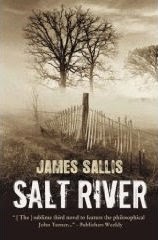
Review of Salt River by James Sallis (No Exit Press, 2010)

John Turner has led an eventful life.  After serving in Vietnam he joined the police, then served time in prison where he trained to become a therapist.  Having tired of listening to the problems of others he moved to small rural town to escape his past but ended up drifting back into police work.  After the death two year’s previously of Val Bjorn, his partner, Turner has been drifting along, taking each day one at a time, dealing with all the problems that afflict a small town in decline.  Then the sheriff’s son drives what appears to be a stolen car into city hall and his old friend Eldon Brown turns up on his porch unsure as to whether he’s committed murder but knowing that the Texas police are hunting for him.  Neither the son’s accident or the accusation against Eldon’s are, however, quite what they seem, and Turner has other issues to also resolve: the friend of a local commune owner is murdered whilst en route to him and a dog that won’t stop barking.

Salt River is the third book in the Turner trilogy, which ideally need to be read in sequence.  At 160 pages it’s more of a novella than novel, but is, I feel, the strongest of the trilogy, in part because the plot is more central than the earlier books, which seemed to concentrate more on the telling of the story rather than the story itself.  Sallis is a poet and it shows in the strength of his prose, which is evocative and haunting, dotted with acute observations and philosophical asides.  The characterisation is nicely portrayed and Sallis weaves a well developed sense of place.  There is no strong hook or sense of urgency or tension, instead the narrative floats along, much like Turner does, sometimes in the flow, other times in the eddies.  The result is a thoughtful, reflexive and compulsive tale about a man still coming to terms with his own bad choices and fate as he muddles through trying to resolve the various issues that are placed in his path.  A superior piece of literary crime fiction.

Thursday, May 8, 2014

Plain versus complex writing

I've recently finished James Sallis' Salt River.  What's enjoyable about his writing is the small asides, observations, and philosophical rumination.  I've had a few conversations recently about styles of writing in academia and the overly complex use of language, so this passage in defense of such expression caught my eye.  It certainly works for Sallis', who nicely produces literary crime fiction.

‘Two schools of thought.  One has it we’re best off using simple words, plain words.  That fancier ones only serve to obscure meaning - wrap it up in swaddling clothes.  Other side says that takes everything down to the lowest common denominator, that thought is complex and if you want to get close to what’s really meant you have to choose words carefully, words that catch gradations, nuances ... You know this shit, Turner.’

‘A version of it.’
 

‘Versions are what we have.  Of truth, our histories, ourselves.  Hell, you know that too.’


Wednesday, July 31, 2013

Review of Cripple Creek by James Sallis (No Exit Press, 2006)

John Turner, an ex-soldier, ex-Memphis cop, ex-con, and former therapist, has retreated into rural Tennessee where he has been persuaded to work as a deputy sheriff.  His life has found a contented rhythm with his new partner, Val Bjorn, a local legal counsel.  However, that is about to change after Don Lee, the acting sheriff, arrests a man from Memphis for speeding and threatening behaviour.  In the trunk of the car is a nylon sports bag containing 200,000 dollars.  Shortly after, the man is sprung from the police station, Don Lee brutally assaulted and left in coma.  Seeking justice, Turner heads to the city, a place that still haunts him, where he violently confronts the gang responsible, but rather than securing closure he opens up a slow burning feud that threatens his new life.

Cripple Creek is the second book in the John Turner trilogy and although best read in sequence can be read as a standalone.  The three standout qualities of Sallis writing, in general, and which are all evident in this story, are his prose, his characterisation, and his atmospherics.  Sallis is a poet and his storytelling has a wonderful cadence, his style is all tell and no show.  The reader is dropped into Turner’s world of rural America and its inhabitants, its sense of place and social life.  Sallis has a keen eye for the human condition and the ways in which life unfolds.  He paints a picture of Turner as an enigmatic man who cyclically creates moments of contentment that unravel through his own follies; a man reflexive of his own propensity to reinvent and self-destruct almost without effort.  It’s a compelling mix.  On the other hand, the plot seems merely a vehicle for these explorations, and whilst interesting has gaping holes in it, especially with respect to police procedures: Turner is seemingly inured against the legal consequences of his actions and in Cripple Creek manages to kill a couple of people without anyone else batting an eyelid or even filling out a form.  If the plot was as skilfully composed as the rest of the tale, the book would be a knockout.  As it is, it’s somewhat of a flawed diamond.


Wednesday, July 24, 2013

Launching oneself into the void

I'm reading Cripple Creek by James Sallis at present.  He's also a poet and it shows in his writing which has a wonderful cadence and is full of atmospherics and reflexive asides.  Parts of the story you could drive a tank through, but it doesn't seem to really matter.  I was particularly taken with his description of consulting:

The business card was for a financial consultant in offices just of Monroe in Memphis.  That consultant thing had always eluded me, I could never understand it.  As society progresses, we move further and further away from those who actually do the work.  Consulting, I figured, was about as far as one could get before launching oneself into the void.

Later on the sheriff says to Turner:

"Don't know if I ever told you this before, but there's times I feel flat-out stupid around you.  We talk, and you tell me what I already know.  Which has got to be the worst kind of stupid."

Seems to me that's what consultants do - tell us what we already know.  For a fee.  The void beckons ...

Friday, November 30, 2012

Review of Cypress Grove by James Sallis (2003, No Exit Press)

Turner is hiding out in the woods somewhere between Memphis and nowhere.  He keeps to himself, letting life drift by until Sheriff Lonnie Bates turns up on his porch seeking help with a murder.  Following a stint in Vietnam, Turner became a Memphis detective, but after shooting his partner was sent to prison.  There he hit the books and studied for a degree and on release built a new life for himself, before abandoning that too for the woods.  Bates cares little for Turner’s past; unused to investigating a violent death he needs his skills.  And deep down Turner needs Bates’ compassion and friendship.  Accepting the challenge, Turner starts on the trail of identifying the dead drifter and who killed him, and of slipping back into society.

Cypress Grove is oddly captivating.  It’s not a page-turner in the sense of a high powered thriller, but rather it hooks the reader in a quiet, understated way.  Sallis’ storytelling kind of just drifts along regardless of dramatic moments, sketching out a portrait of an essentially good man whose life has been punctuated by terrible moments: being drafted to Vietnam, killing his partner, killing a prison inmate just prior to being released; all of them somehow beyond his control.  Sallis’ is a noted poet and essayist as well as novelist and it shows in his writing, which has a lyrical cadence and some lovely turns of phrase.  The story is told through two intersecting plotlines that alternate across chapters; one in the present; the other Turner’s back story.  It’s an effective structure, providing a series of interesting counterpoints.  The plot itself is relatively straightforward and Turner solves the case quite easily, but the puzzle is hardly the main focus of the story, rather it's Turner’s journey and the unfolding of his re-integration into life and law enforcement.


Friday, December 23, 2011

Review of The Killer is Dying by James Sallis (No Exit Press, 2011)

For forty years Christian has advertised as a disposer of dolls. Seriously ill he is working what will probably be his last hit. Someone else however gets there before him, though they botch the job. Sayles, a tired cop nearing the end of his career, and his partner Graves are assigned to the case. Not wanting to die a slow painful death in front of her husband, Sayles' wife, Josie, has fled to an anonymous hospice. Meanwhile, Jimmie, a young teenager abandoned by his parents, wheels and deals on ebay to pay the household bills and create the impression that he's not living home alone. Used to dreamless nights, he's started to have the vivid dreams of a killer. The three lonely men orbit around each other as Christian hunts for the person who attacked his target, Sayles works the case, and Jimmie tries to maintain his illusion.

I found The Killer is Dying a curious read. It's elliptical, layered and somewhat ponderous, seeming to almost skirt around the edges of what might be considered the main story (the attempted killing of Rankin). For a short book, it's full of asides and tangent observations. The reader is given entry ways into the lives of the three main characters, small samples of their back stories, but it all remains a little bit elusive and enigmatic. One part of me liked this as it invited the reader to work with the author, another part found it frustrating that so much was left tantalizingly out of reach. Having reached the final page, my overall sense was that I never really felt I got to know either the case or the characters to any sufficient degree. Sallis' writing is prose with a nice cadence. His style and how he approaches the story has its charms, but for my tastes the story needed a little more depth and definition. There was enough here, however, that I'll give another one of his books a go.