Showing posts with label Salt River. Show all posts

Friday, May 16, 2014

Reading books about crime fiction

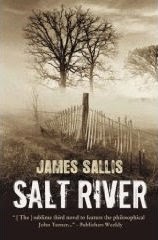
Earlier in the week I reviewed James Sallis’ Salt River.  In the frontispiece there’s a short review of the book by Woody Haut.  This is how he starts his piece:

In this, his third Turner novel, Sallis demonstrates the degree to which his writing reflects his long held revisionism regarding the poetics of the genre.  More interested in plot as a process rather than a means to an end, Sallis’s narratives invariably include fictional memoir, meaningful quotations, episodic rumination, diversions, non-sequiturs and a great deal of atmosphere.

His observations are spot on.  Not only does it capture the style of a great book, but Haut's review also made me want to go and read his own books, which chart the history and evolution of American crime fiction: Heartbreak and Vine: The Fate of Hardboiled Writers in Hollywood; Pop Culture: Hardboiled Fiction and the Cold War; and Neon Noir.  All three have recently been re-issued by 280 Steps.  I’ve shied away from reading books about crime fiction in favour of reading the fiction itself.  Maybe it's about time I started to rectify this state of affairs.

Monday, May 12, 2014

Review of Salt River by James Sallis (No Exit Press, 2010)

John Turner has led an eventful life.  After serving in Vietnam he joined the police, then served time in prison where he trained to become a therapist.  Having tired of listening to the problems of others he moved to small rural town to escape his past but ended up drifting back into police work.  After the death two year’s previously of Val Bjorn, his partner, Turner has been drifting along, taking each day one at a time, dealing with all the problems that afflict a small town in decline.  Then the sheriff’s son drives what appears to be a stolen car into city hall and his old friend Eldon Brown turns up on his porch unsure as to whether he’s committed murder but knowing that the Texas police are hunting for him.  Neither the son’s accident or the accusation against Eldon’s are, however, quite what they seem, and Turner has other issues to also resolve: the friend of a local commune owner is murdered whilst en route to him and a dog that won’t stop barking.

Salt River is the third book in the Turner trilogy, which ideally need to be read in sequence.  At 160 pages it’s more of a novella than novel, but is, I feel, the strongest of the trilogy, in part because the plot is more central than the earlier books, which seemed to concentrate more on the telling of the story rather than the story itself.  Sallis is a poet and it shows in the strength of his prose, which is evocative and haunting, dotted with acute observations and philosophical asides.  The characterisation is nicely portrayed and Sallis weaves a well developed sense of place.  There is no strong hook or sense of urgency or tension, instead the narrative floats along, much like Turner does, sometimes in the flow, other times in the eddies.  The result is a thoughtful, reflexive and compulsive tale about a man still coming to terms with his own bad choices and fate as he muddles through trying to resolve the various issues that are placed in his path.  A superior piece of literary crime fiction.

Thursday, May 8, 2014

Plain versus complex writing

I've recently finished James Sallis' Salt River.  What's enjoyable about his writing is the small asides, observations, and philosophical rumination.  I've had a few conversations recently about styles of writing in academia and the overly complex use of language, so this passage in defense of such expression caught my eye.  It certainly works for Sallis', who nicely produces literary crime fiction.

‘Two schools of thought.  One has it we’re best off using simple words, plain words.  That fancier ones only serve to obscure meaning - wrap it up in swaddling clothes.  Other side says that takes everything down to the lowest common denominator, that thought is complex and if you want to get close to what’s really meant you have to choose words carefully, words that catch gradations, nuances ... You know this shit, Turner.’

‘A version of it.’
 

‘Versions are what we have.  Of truth, our histories, ourselves.  Hell, you know that too.’