Thursday, December 13, 2018

Review of Angelmaker by Nick Harkaway (2012, Windmill Books)

Joe Spork is the son of a master-criminal, who when he wasn’t conducting daring robberies was running London’s Night Market, a secret place to fence stolen wares. His grandfather was a master-horologist, repairing all manner of clocks and clockwork machines. Joe has chosen to turn his back on father’s mobster world and follow in his grandfather’s footsteps, though he remains friends with some of his father’s associates. His world, however, is turned upside down by Edie, an octogenarian superspy, a secret government department, a cultish group of engineers known as the Ruskinites, the psychopathic ruler of an Indian state, and a complex, clockwork Doomsday machine built by a genius Frenchwoman for the British in the 1950s. Unwittingly, Joe re-activates the machine, triggering several international incidents and making himself the number one most wanted man in Britain. Joe is the only person who can save the world, but he’s well out of his depth and everyone seems to be conspiring against him except for his father’s associates, their law firm, and the woman of his dreams.

It's kind of difficult to describe Angelmaker. The publisher goes with “gangster noir meets howling absurdist comedy”. I think ‘science fiction, thriller, spy adventure and romance’ can be added to that. It’s a big, ambitious tale spanning seventy years, rooted in the exploits of Edie Banister, a British superspy, a kind of female version of James Bond, a genius Frenchwoman who sees the world as numbers and constructs fantastic clockwork machines, and a psychopathic ruler of an Indian state who has ambitions to become a god. Into the legacy of their world is dragged Joe Spork, the son of a master-criminal, and grandson of a master-horologist, who would like to live a nice quiet life. Unhappy with how the world has turned out, Edie tricks Joe into re-activating a Doomsday machine that seeks to improve the world but actually causes personal harm and international incidents. Despite being a patsy, Joe is suddenly a marked man, pursued by a shady government department and a group of mad monks. Harkaway tells the story through two main threads: one following the exploits of Joe Spork as he tries to stay alive and fix the mess he’s created; the other providing a detailed backstory of Edie, her spy career and the history of the Doomsday machine. Woven into the mix are a number of subplots. The result is a sprawling tale packed with invention, philosophy and action. The characters are very nicely developed and some of the set pieces are delightfully done. The plot is clever, multi-layered and complex, yet straightforward to follow. If you like to wallow in thick description, then you’ll love the attention to detail and expansive narrative. Personally, I would have liked it to be tightened up a little throughout, especially in the first two thirds, which felt a little uneven, bloated and indulgent, consisting of interlinked set pieces and containing material that had no real bearing on the story and slowed the momentum of what felt like it should be a thriller. Thankfully the latter third was more even and rooted in the tale. Overall, an engaging and fun, if overly long, read.

Tuesday, December 11, 2018

Review of City of the Dead by Sara Gran (Houghton Mifflin Harcourt, 2011)

Having discovered a copy of Jacque Silette’s ‘Détection’ as a teenager, Claire DeWitt was always destined to be a private investigator. Her path to being the self-proclaimed world’s greatest detective has not been straightforward, however. A teenage friend disappeared never to be found, her Silette-trained mentor, Constance, was murdered, and she’s recovering from a major nervous breakdown. When she’s asked to take a job in New Orleans to find a missing district attorney post-Katrina, she knows she’ll be encountering more than the case. DeWitt was schooled by Constance in the city and she still has acquaintances there. She finds the city still in turmoil months after the hurricane. The DA seemingly vanished without a trace. Drawing on her copy of Détection, her dreams, I Ching dice and contacts, she starts to investigate, partly hunting for clues, partly creating noise to see what happens. It seems though that nobody really wants the truth to out.

Claire DeWitt is somewhat of an unusual private detective. She is a devotee of the philosophy and methods of French detective, Jacque Silette, author of ‘Détection’, religiously following his oblique advice, and drawing on her dreams and I Ching dice to cast light on cases. She’s headstrong, abrasive and self-assured, yet is also carrying a lot of emotional baggage and mental health vulnerabilities. Her first case after residing in a retreat after a nervous breakdown is to find out what happened to a missing district attorney in New Orleans after the Katrina floods. It is a city that holds many memories given that is where she trained under the mentorship of Silette-apprentice, Constance. The city is a still a mess and the crime rate sky high. DeWitt starts with the DA’s clients, young black men hanging around on street corners, making friends and enemies at the same time. It took me a bit of time to get into the tale as the storytelling somewhat drifts much like DeWitt’s approach to the case, at times focusing on the detective and parts of her backstory, at times exploring Silette’s philosophy, and otherwise spooling out the case and the city of New Orleans post-Katrina. At about halfway through I settled into the cadence and style and started to warm to DeWitt. The denouement was not a surprise, but this was a story about the journey not the destination. 


Sunday, December 9, 2018

Lazy Sunday Service

I've been working a bit on how digital technologies change the pace, tempo and organization of everyday life, and read the book 'Rest' by Alex Soojung-Kim Pang during the week. If you feel you need to slow your life down and get some balance without compromising on productivity, it might be worth checking out.


My posts this week
Review of Red Plenty by Francis Spufford
Review of African Sky by Tony Park
November reads
But what about our flight?

Saturday, December 8, 2018

But what about our flight?

The plane was almost empty and they were trapped in a row of three.

Janice waved at an air hostess.

‘Are you okay, Miss?’

‘We think he’s dead.’ Mary pointed at the man next to her.

‘Dead? Sir?’ The hostess shook the man’s shoulder. ‘Sir?’

The man’s head lolled to one side.

‘Kevin!’

‘We need to get off,’ Janice said. ‘We have a connecting flight.’

‘But …’

‘We have a wedding. My brother’s.’

A tall man arrived.

‘He seems to be dead.’

‘Dead?’

‘Please, we need to get out.’

‘Sir? I’ll call for a medic.’

‘But what about our flight?’


A drabble is a story of exactly 100 words.

Friday, December 7, 2018

Review of Red Plenty by Francis Spufford (2007, Faber and Faber)

After Stalin dies Nikita Khrushchev comes to power. He makes a rash challenge that by 1980 the Soviet Union will have overtaken the United States as the world’s economic power house: a socialist, planned economy he predicts will grow faster and lift all boats, unlike the vagaries and divisions of capitalism. What would make this happen was a shunning of profit as the organising logic and an embracing of cybernetics. For a brief time it appeared as if the Soviets could catch up to the US with year-after-year exceptional growth and scientific and technological breakthroughs with respect to space and the military. But then the wheels started to come off and growth slowed.

Francis Spufford tells this story through a blend of history and fiction. It’s an interesting approach that works remarkably well. It’s aided by some superb prose and inventive, captivating storytelling. Moreover, Spufford does an excellent job of explaining complex science and economics through a fiction narrative (there’s definitely a lot that non-fiction writers could learn from this). The tale is told through a series of short stories, each focusing on a particular situation and character – a scientist/economist, a politician, a party-affiliated worker, a fixer, etc. – and their role in society and economy. The stories are spread over a decade from the late 1950s to late 1960s and they illustrate why the Soviet planned economy and the cybernetic approach failed to deliver on its promise (basically people and politics corrupt any system, and close modelling and planning of literally millions of moving components and variables is analytically impossible). The first two thirds is exceptionally good. The latter third the tale runs out of steam a little and the wrap-up is a little thin, meaning the tale as a whole kind of peters out. Nonetheless, Red Plenty is a fascinating read told through some scintillating storytelling.


Wednesday, December 5, 2018

Review of African Sky by Tony Park (Pan, 2006)

Rhodesia, 1943. Felicity Langham, a high-profile WAAF working at Kumalo air base, is found raped and murdered. Pip Lovejoy, a farmer married to an army officer fighting in Italy and working as a policewoman, is involved in the investigation. Her boss quickly arrests a local man who is active in the black market. Pip is not convinced the man is the murderer and tries to keep the case active. After flying close to sixty missions over occupied Europe and Germany, Paul Bryant is now second in command at the airbase. He knew Langham intimately, but he’s also got problems, including a missing plane and a murdered pilot, and a second plane damaged on landing at the farm of Catherine De Beers, who coincidentally was a very close friend of Langham. Lovejoy and Bryant team up to solve their respective cases, but the evidence points to Bryant having more than a passing interest in the Langham case. Meanwhile, a darker force is at work.

African Sky is part romance, part murder mystery, and part spy adventure tale set in Rhodesia in 1943. The story revolves around two murders related to Kumalo air base, a site where thousands of airmen are trained in skies free of enemy aircraft before shipped to Europe for active service. The first murder is of a young daredevil WAAF, the second a pilot killed after landing his plane in the bush. Pip Lovejoy a local white farmer turned policewoman is investigating the first, Paul Bryant an Australian veteran of bombing runs over Germany the latter. They team-up to investigate their cases. While the romance and murder mystery element work okay, the spy adventure part of the tale is much weaker. In part, it is because the storyline is at the limit of plausibility, and in part, because this aspect of the story has lengthy back story tangents that detract from the main storyline. The result is a denouement that has plenty of action, but is overly melodramatic and far-fetched. Overall, some interesting history, a nice romantic hook-up, but a story that didn’t quite fit neatly enough together.


Monday, December 3, 2018

November reads

I might get one five star read a month if I'm lucky, then three of them come together in quick succession. Two of this month's five star reads relate to corrupt cops, the other is about people struggling to get by in inner city Dublin. Difficult to pick a book of the month, but I'm going with The Force by Don Winslow given the sheer ambition and complexity of the tale.

The Force by Don Winslow *****
Taroko Gorge by Jacob Ritari ***.5
Ghost Month by Ed Lin **
Exit Berlin by Tim Sebastian ***.5
The Last Days of Jack Sparks by Jason Arnopp ***
Early One Morning by Robert Ryan ****
Sirens by Joseph Knox *****
A House of Ghosts by W.C. Ryan ****
Rain Falls on Everyone by Clár Ni Chonghaile *****


Sunday, December 2, 2018

Lazy Sunday Service

I wandered into town yesterday to pick up an order of books, and wandered back with twice as many as planned. I think these look like a good mix and should keep me going a month or two into the new year. I've already made a start on Sara Gran's City of the Dead.

My posts this week:
Review of The Force by Don Winslow
Review of Taroko Gorge by Jacob Ritari

Heart of Stone

Saturday, December 1, 2018

Heart of stone

‘He has a heart of stone, Jane. I’m glad I left.’

‘Well, it’s like crazy paving now.’

‘Unlikely.’

‘I’m telling you, Maeve, he’s missing you.’

‘The only thing he’s missing are his hot dinners and clean clothes.’

‘That’s a bit harsh.’

‘If you’re so worried about him, then you’re welcome to him.’

‘I’m just saying, is all. He still cares for you.’

‘Then he should have shown it when we were together. I’m happier by myself.’

‘Really?’

‘Of course. It’s not easy, money-wise, but there’s freedom.’

‘And what about, John?’

‘He sent you; couldn’t even do it himself. Feck, John.’


A drabble is a story of exactly 100 words.

Thursday, November 29, 2018

Review of The Force by Don Winslow (2017, HarperCollins)

Sergeant Denny Malone runs a special task force in North Manhattan, tangling with various drugs gangs and trying to keep the peace. He believes in facing fire with fire, brazenly policing through fear and violence and doing deals with gang leaders and Mafioso, and he’s prepared to reward himself and his crew by helping himself to criminal assets. Things start to go wrong when he tangles with and kills a drug lord, one his team also dies in the raid, and the crew help themselves to several million dollars and fifty kilos of premium heroin. Now routinely well over the blue line, Malone is cornered by the Feds. They want the names of corrupt lawyers and police. He is not prepared to give up fellow officers, but once you’ve turned rat, you’re on a slippery slope. Malone is a schemer, however, and he knows the secrets of many supposedly upstanding citizens, that everyone is playing a crooked game, and they also have a price.

The Force is a tour-de-force police procedural, with well-drawn characters, a strong sense of place, and a complex, multi-layered, intricate plot that has more twists and turns than a bowl of spaghetti. These alone deserve five stars, but what elevates the book is its wider political and social reflections. Most crime fiction is also usually a slice of social realism that provides a commentary on society and its ills. That commentary is often incidental, with the focus of the narrative on the crime, the characters and the plot. In The Force, it’s front and centre. Winslow’s ambitious tale of cops on the take in New York is not simply an engaging, compelling tale, but a searing exploration of law and justice in the US. But having got to the end, I’m still not quite sure what the message is; but perhaps that’s the point.

Denny Malone and his crew police North Manhattan with an iron fist, as vicious and brutal as the gangs they take on daily, and the price they extract for maintaining some kind of law and order is skimming money from drug busts and receiving other gifts and favours. Their form of policing is based on fear and doing deals with the gangs and mafia. To the media they are hero cops who make key busts manage to contain the crime and violence in the city. Winslow also plays them both ways – as criminal and corrupt as those they police and also good cops keeping the neighbourhoods safe and providing for their families. Even as Malone goes off the rails, crossing every line a cop should never cross, Winslow has him oscillating between good and bad cop – asking the reader to empathize and sympathize with a man who has lost his moral compass. On the one hand, Malone and his crew are the inevitable outcome of a failed society and corrupt justice system – from dodgy police, to crooked lawyers and prosecutors, bought judges, and slippery politicians – but on the other, they make their own choices and lie in their own beds. They are caught between structure and agency, to borrow from sociology textbooks.

And this is where Winslow’s message gets mixed: we're asked to believe that Denny Malone remains a good man despite his crimes; that society and justice and legal system is so flawed and corrupt that price of some kind of law and order is a police service who can only do good through being crooked. Yet, the story screams out that society and the system needs urgent repair, or indeed a thorough reworking given its biases and flaws; that neither the crimes or the police actions should be condoned. The story is so rich, multi-layered and thought-provoking, however, that I’m sure other readers have varying takes. And this is the real beauty of the novel: it provides a rich tapestry through which to consider the urban society and the state of law and order in the US. Overall, then, a thoroughly engaging novel that deserves to be read and re-read; a great American-novel for the times we live in.

Monday, November 26, 2018

Review of Taroko Gorge by Jacob Ritari (2009, Unbridled Books)

Peter Niels is an American journalist who used to cover war-torn parts of the world, but has shifted to general interest pieces and has travelled to Taiwan to research a story on religion. He’s accompanied by Pickett, a photographer. The pair travel to the Taroko Gorge, a national park and one of the island’s better known tourist destinations, and one of its Buddhist temples. Resting along a path, three Japanese school girls wander by. It is the last time they are seen and when they fail to return to their coach and class mates the alarm is raised. By the time the police arrive it is dark and the search will have to wait to the following day. Niels and Pickett, along with the Japanese teacher and four class mates remain at the site, staying in the visitor centre. Already tense due to the disappearance of the girls, they start to bicker and simmer, and the approach of a typhoon adds to the strain.

Taroko Gorge focuses on the unfolding drama of three Japanese school girls going missing in a Taiwanese national park. The last two people to see them are a disillusioned American journalist and his drunken photographer. Their class mates did not see them slip away or have no idea as to where they were headed. As night falls, a local police inspector who is wary of the involvement of Americans and Japanese visitors arrives. Unable to search in the dark, the Americans, the teacher and four school children remain on site, staying in the visitor centre.  Ritari explores the disappearance and the subsequent wait and search through four of the characters – Peter Niels, the journalist; Tohru Maruyama, the class rep; and Michiko Kamakiri, a jealous classmate of the missing girls; and Hsien Chao, the detective – using four first person voices. The resulting perspectives enable the reader to piece together what happened and why, which no-one character has a full-handle on. Ritari does a nice job of elaborating the characters and the relationships between them, with the emotional games of the school children replicated amongst the adults, who can’t help but think the worst of each other. The mystery of the disappearance is also nicely revealed. The overall effect is a story that is more like a play, exploring human nature with the characters limited to the stage of the gorge and visitor centre.

Sunday, November 25, 2018

Lazy Sunday Service

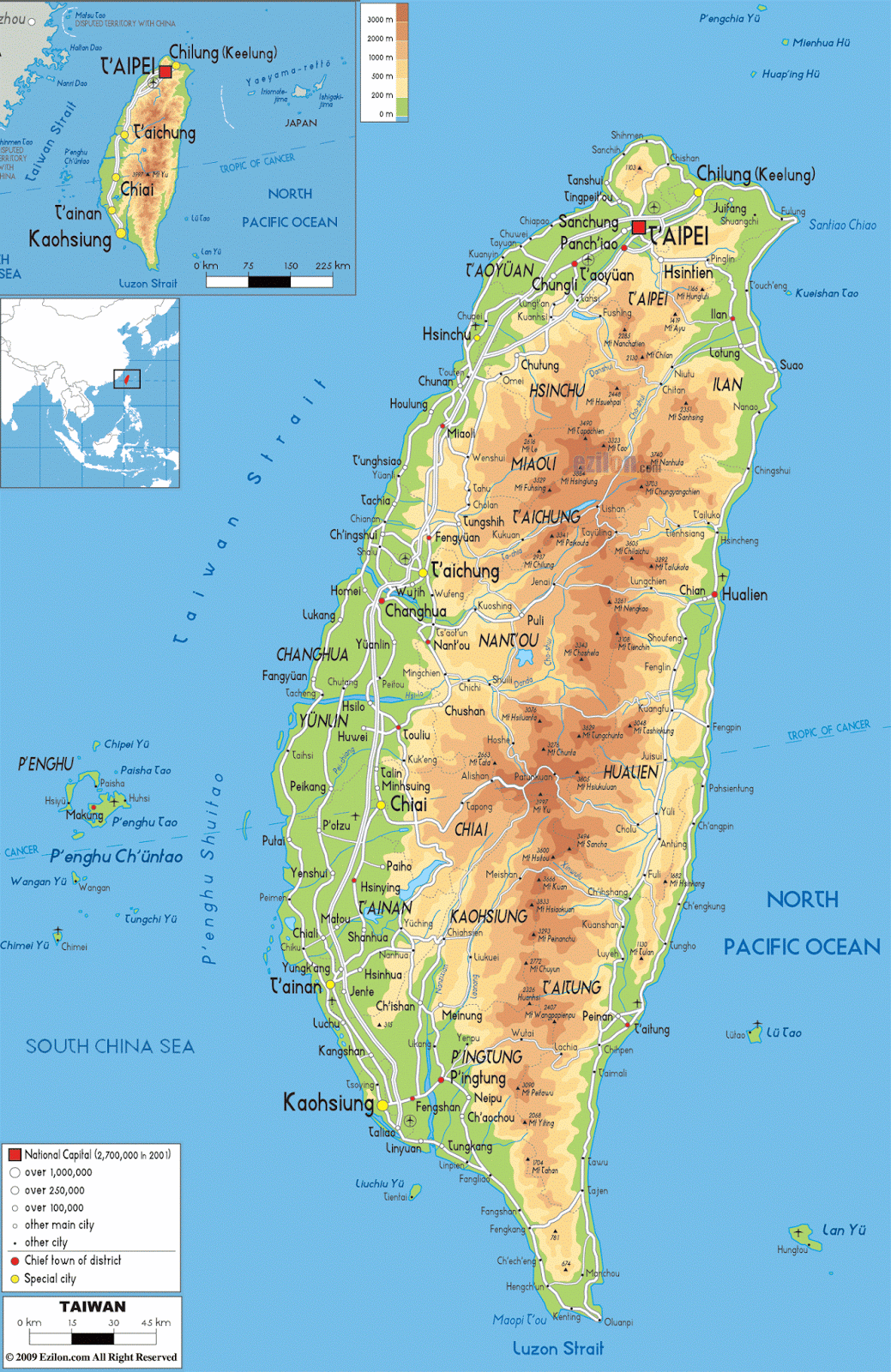
Back from a week in Taiwan, where I gave a couple of talks - one at the Contemporary Culture Lab in Taipei and one at Tunghai University in Taichung. An interesting place to visit and a bit of a contrast to Ireland in terms of climate, geography and culture. The island is about 40 percent the size of the island of Ireland, but it has four times the population, most of which is along the west coast as much of the land is very mountainous (some of which also four times the height of any in Ireland). I thoroughly enjoyed my time there and have already agreed to visit again next year some time. I'll need to find some more Taiwanese fiction to read by then.

My posts this week
Review of Ghost Month by Ed Lin
Review of Exit Berlin by Tim Sebastian
At last